Commercial definition
Identity lens: 316 scrap refers to material represented as belonging to the molybdenum-bearing 316 austenitic stainless family, often arising from process equipment, pipework, marine service or production offcuts.
A sourcing brief for molybdenum-bearing austenitic stainless scrap. 316 scrap refers to material represented as belonging to the molybdenum-bearing 316 austenitic stainless family, often arising from process equipment, pipework, marine service or production offcuts. Service history is informative but not proof of grade.
Desk answer
The 316 family is commonly differentiated from 304 by its molybdenum-bearing designation, but neither visual inspection nor application history alone establishes composition.
Applications
Typical users, supply profiles and points to clarify before a discussion.
Downstream route: Verified 316-family scrap can be prepared for stainless producers and specialist alloy processors whose blend calculations account for the delivered chemistry.
Identity lens: 316 scrap refers to material represented as belonging to the molybdenum-bearing 316 austenitic stainless family, often arising from process equipment, pipework, marine service or production offcuts.
Grade lens: References such as 316, 316L, EN 1.4401 and EN 1.4404 describe related variants and standards; they should not be collapsed into one universal specification.
Inspection lens: Positive material identification is often important because 304 and 316 can look alike.

Grade identity and origin
Stainless steel scrap sold as 316 or 316L belongs to a related austenitic family, yet the low-carbon L designation remains commercially relevant and should be retained when records support it. A trade name alone does not establish the exact grade.
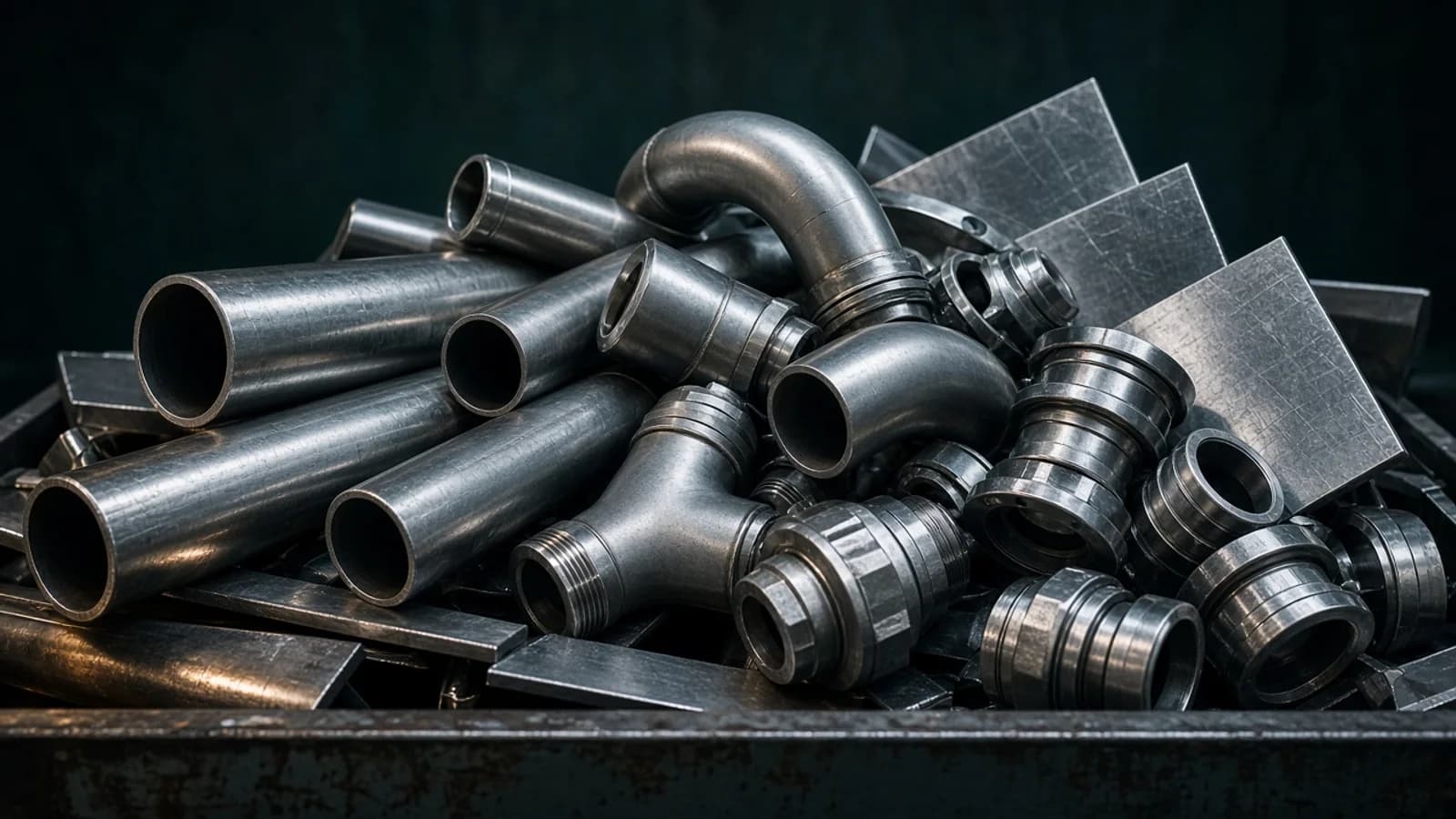
Typical origins include food and chemical process vessels, heat exchangers, pharmaceutical pipework, marine fittings, fabricated tanks and clean production offcuts. Keeping demolition pieces apart from traceable factory arisings preserves useful identity.
Chemistry under review
Molybdenum is the principal alloying feature used to distinguish 316-family scrap from common 304 material, alongside chromium and nickel. Its presence and level affect melt-shop blending, but appearance, magnet response and service location cannot quantify chemistry.
Purchase terms can define the analytical method, elements reported, instrument calibration and treatment of mixed readings before pricing. Handheld screening may guide sorting, while the receiving plant may require laboratory analysis for final classification.
Alloy separation
Clean visual similarity makes 304 a recurring dilution risk in a 316 scrap parcel. Duplex stainless, 317-type material, nickel-rich alloys, ferritic grades and plated carbon steel can also distort a lot when dismantling streams converge.
Segregation works best at the point of generation, using labeled containers, controlled cutting areas and quarantine for uncertain pieces. Welds, valves, fasteners and attachments deserve separate checks because they may not match the parent equipment.
Lot evidence
Equipment history can reveal contact with chlorides, acids, food products, pharmaceuticals or heat, and can flag coatings or trapped process matter. It informs inspection and safe handling without proving either grade or freedom from contamination.
A lot plan can combine positive material identification with representative sampling across sizes, sources and containers rather than testing only accessible surfaces. Records should link readings, sample locations, residue observations and rejected pieces to the shipment.
Melt-ready delivery
Preparation for melting may include draining, cleaning, removing non-metallics, separating oversized pieces and cutting to dimensions accepted by the chosen furnace. Packing should control sharp edges, loose turnings, moisture and unsafe movement in transit.
The commercial file should identify origin, declared grade family, net weight, preparation method, inspection results, photographs and any applicable transport or waste documents. Acceptance limits and discrepancy handling belong in the contract, not in an assumed guarantee.
Specifications
Indicative review points for Stainless Steel 316 Scrap. The agreed specification belongs in the transaction documents.
Qualification reference only. Values and tolerances must be agreed for the specific lot or supply programme.
How we work
First establish: 316 scrap refers to material represented as belonging to the molybdenum-bearing 316 austenitic stainless family, often arising from process equipment, pipework, marine service or production offcuts.
Then verify: Positive material identification is often important because 304 and 316 can look alike.
Route against: Verified 316-family scrap can be prepared for stainless producers and specialist alloy processors whose blend calculations account for the delivered chemistry.
Before dispatch: Process pipe and vessels may retain liquids or residues, while cut sheet and solids create sharp-edge and density concerns.
FAQ
Practical questions about preparing a Stainless Steel 316 Scrap file.
Contract answer: References such as 316, 316L, EN 1.4401 and EN 1.4404 describe related variants and standards; they should not be collapsed into one universal specification.
Inspection answer: Positive material identification is often important because 304 and 316 can look alike.
Important limit: No.
Document answer: Process pipe and vessels may retain liquids or residues, while cut sheet and solids create sharp-edge and density concerns.
Related insights
No related insight is currently published for this product.
Reference sources
Commodity workspace
Supporting view for qualification and preparation.
Related commodities
Turco & Co
Company and contact details form part of the intake review.
Commercial files coordinated worldwide across major trade regions.
Specifications, certifications and shipping documents coordinated where applicable.
A reviewed file follows a clear contact route as the discussion progresses.