
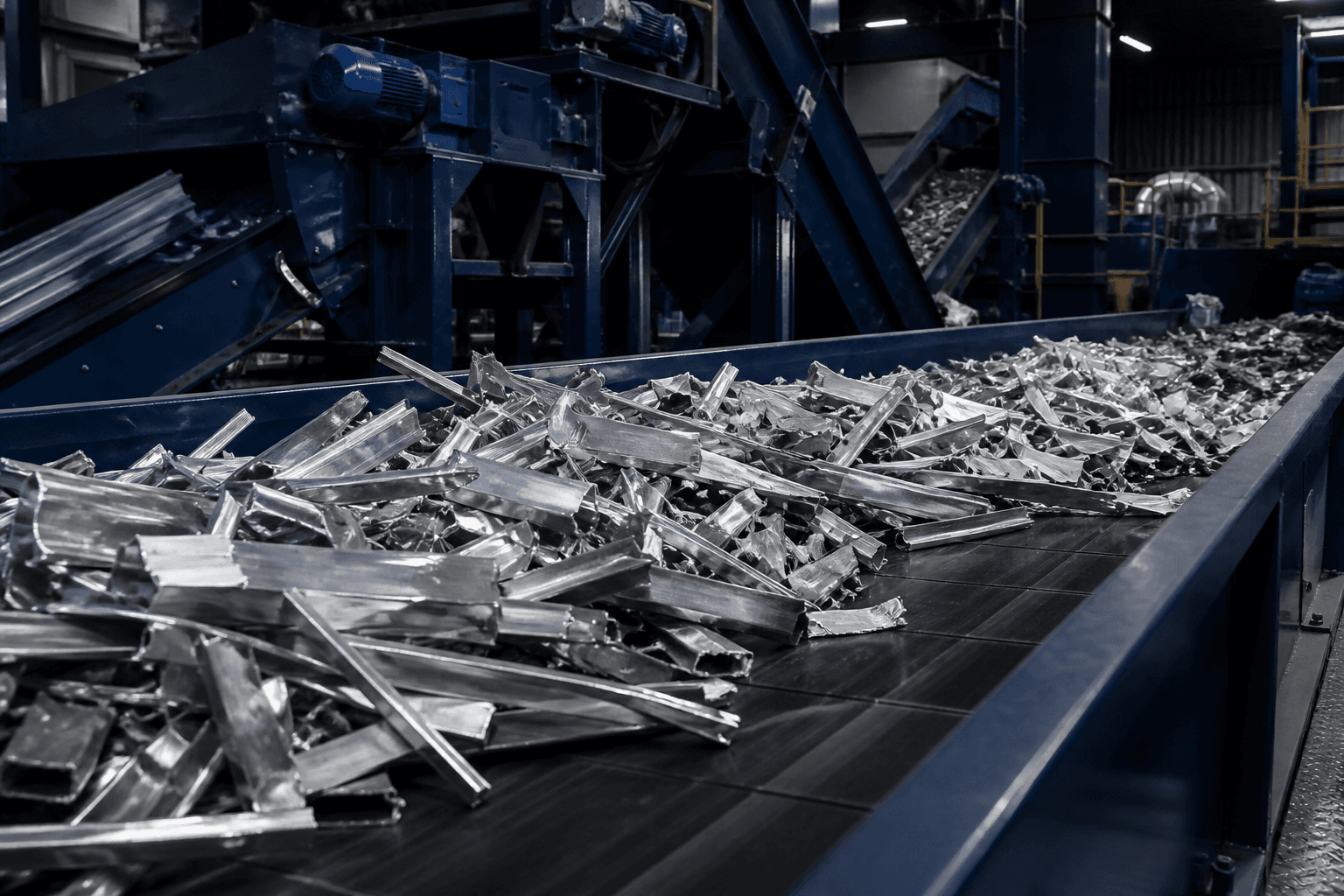
International trade in aluminium scrap is governed less by a single global standard than by a layered system of trade grades, regional sorting practices, and remelter-specific alloy tolerances. For industrial buyers sourcing feedstock for secondary smelters and for exporters consolidating mixed post-consumer arisings, the difference between a profitable shipment and a rejected container often comes down to grade nomenclature, alloy contamination control, and export documentation that matches the physical reality of the load. This guide explains how ReMA/ISRI aluminium grades are applied in practice, where Taint-Tabor, Tense, and Talon fit in commercial contracts, and what documentation desks verify before approving cross-border movement.
Why aluminium scrap grading matters in physical trade
Unlike exchange-traded primary aluminium, scrap is heterogeneous. Two loads described as "mixed aluminium scrap" can differ materially in melt yield, flux requirement, tramp element content, and suitability for a given cast-house product mix. Grading systems exist to reduce information asymmetry between seller and buyer, but they are not self-enforcing: the grade on a contract is a shorthand for an expected composition band, not a guarantee until verified by inspection, sampling, or processing trial.
Secondary aluminium producers — remelters, die-casters, and rolling mills with scrap intake — typically price against London Metal Exchange (LME) primary aluminium benchmarks, then apply discounts or premiums based on grade purity, logistics, and regional supply-demand. Exporters and traders who understand grade boundaries can structure sorting investments that unlock better netbacks; buyers who specify grades precisely can avoid costly furnace surprises.
ReMA, ISRI, and the Scrap Specifications Circular
In North America, the Recycled Materials Association (ReMA, formerly ISRI) publishes the Scrap Specifications Circular, which defines alphanumeric codes for non-ferrous scrap including aluminium. These codes — Taint-Tabor, Tense, Talon, Taldon, Tabloid, and dozens of others — are widely referenced in export contracts even when neither party is US-based, because they provide a shared vocabulary that predates many national waste codes.
ReMA grades describe form, alloy family, and contamination limits in trade language rather than laboratory certificates. For example, Tense typically refers to mixed old alloy sheet and solids of various aluminium alloys, while Talon covers aluminium castings including mixed alloy content. Taint-Tabor (often written Taint/Tabor or TT) is one of the most traded mixed aluminium grades globally: old sheet, litho, 1100-series and other wrought scrap in a defined mix, with limits on attachments, free moisture, and non-aluminium contamination.
European buyers may additionally reference EN or national waste codes, and shipments into the EU must align with waste shipment regulation classifications. The ISRI/ReMA code on the invoice does not replace legal waste characterisation — it complements it for commercial quality purposes.
Source: Recycled Materials Association (ReMA), Scrap Specifications Circular — non-ferrous aluminium grade definitions; ISRI historical nomenclature retained in international trade practice.
Core aluminium grades used in export trade
- Taint-Tabor (TT): Mixed old aluminium sheet and solids; workhorse export grade when properly sorted. Premiums depend on low iron, low zinc, and minimal painted or coated content.
- Tense: Mixed wrought alloy scrap — extrusions, sheet, and solids — often sorted to a higher alloy consistency than TT but still multi-alloy.
- Talon: Aluminium castings; higher silicon content typical of casting alloys. Often priced separately from wrought grades because remelter yield and product routing differ.
- Taldon: Clean aluminium clippings and solids, often new production scrap (prompt) or tightly sorted post-industrial material.
- Tabloid: New, clean aluminium lithographic sheet scrap; tighter specification, higher value when moisture and paper residue are controlled.
- Twitch / Zorba downstream: After sensor-based or dense-media separation of shredded mixed non-ferrous (Zorba), aluminium-rich fractions may be sold as Twitch or further sorted into grade-specific packages.
Grade names describe an expected composition band agreed by trade custom. They do not replace pre-shipment inspection when the buyer pays on delivered quality or when regulatory authorities require waste characterisation.
Alloy contamination: the hidden cost in mixed loads
Aluminium scrap value is driven as much by alloy chemistry as by form. Remelters casting 3xx series products cannot indiscriminately absorb high levels of 2xxx (copper-bearing) or 7xxx (zinc-bearing) scrap without recipe adjustment, dilution with primary ingot, or off-spec output. Mixed grades like Taint-Tabor and Tense therefore trade at discounts that reflect expected tramp elements and the cost of upgrading.
Common contamination vectors
- Iron and steel attachments: Fasteners, steel inserts in castings, and magnetic contamination increase flux consumption and slag volume.
- Copper and brass: Even small copper pick-up from heat exchangers or fittings can disqualify material for certain automotive or electrical alloy targets.
- Zinc and magnesium: Common in die-cast and 7xxx wrought scrap; tolerances vary by buyer.
- Paint, lacquer, and plastics: Organic content affects melt loss, emissions compliance, and filter life.
- Free moisture and oil: Explosion risk in furnaces and weight fraud in wet loads; moisture limits are standard in export specs (often 1–2% max free moisture).
- Cross-alloy mixing: Deliberate or accidental mixing of cast and wrought, or of heat-treatable with non-heat-treatable alloys, reduces melt flexibility.
Advanced sorting — eddy current separation, XRF hand sorting, LIBS-based sorting lines — allows exporters to split mixed arisings into higher-value fractions. The economics depend on labour cost, throughput, and the premium achievable in the destination market (Turkey, India, Southeast Asia, Europe, and North America each have different grade preferences and environmental rules).
Sorting operations and export preparation
Export-ready aluminium scrap typically passes through a sequence of receiving, sizing, magnetic separation, manual picking, and baling or container loading. For containerised shipments, bale density and wire tie quality affect both freight efficiency and customs inspection outcomes. Loose-loaded containers are common for TT and Tense when baling would embed contamination; either way, photographic documentation at load and seal numbers are standard operational controls.
From mixed arisings to named grade
Municipal and construction arisings often enter as Zorba or mixed non-ferrous from auto shredder residue downstream plants. Traders who invest in secondary sorting capture margin by upgrading Zorba into Twitch (aluminium-rich) and then into Tense or alloy-specific packages. The capital intensity of sorting lines means many exporters operate as consolidators: they buy pre-sorted TT from multiple small yards and perform final quality control before export booking.
Moisture management is operational, not theoretical. Scrap stored outdoors before containerisation can fail destination moisture clauses even when the underlying metal quality is acceptable. Covered storage, drainage, and load-out during dry weather are part of export qualification.
Source: International Aluminium Institute (IAI), statistics and recycling flow publications on end-of-life aluminium collection and secondary production; Basel Convention technical guidelines on environmentally sound management of metal scrap.
Documentation for international aluminium scrap shipments
Export documentation must satisfy three overlapping audiences: customs and border agencies (product classification and waste rules), the buyer's import and finance team (commercial invoice match to contract), and the remelter's compliance function (origin, sanctions, and environmental due diligence).
Commercial and logistics documents
- Sales contract or proforma: Grade code (e.g. ISRI Taint-Tabor), quantity tolerance, price basis (LME discount, fixed price, or index-linked), Incoterms, payment terms, inspection rights.
- Commercial invoice: Grade description consistent with contract; HS code appropriate to aluminium waste/scrap classification in exporting and importing country.
- Packing list: Bale count, average bale weight, container numbers, seal numbers.
- Bill of lading: Clean on board or received for shipment per Incoterms; consignee and notify party aligned with letter of credit if applicable.
- Certificate of origin: Required for preferential duty treatment where applicable; must match actual processing country rules.
- Weight certificate: Weighbridge or port scale; disputes often arise on moisture and tare.
Waste shipment and regulatory documents (EU and OECD context)
Shipments of aluminium scrap from OECD countries to non-OECD destinations, or into the European Union, may fall under the Basel Convention and regional implementations such as EU Waste Shipment Regulation (WSR). Green-list scrap meeting certain purity and contamination criteria can move under simplified procedures; other flows require notification and consent. Exporters must characterise material against the legal definition of waste vs non-waste in both jurisdictions — a commercial "grade" does not automatically determine regulatory status.
For EU imports, classification under Annex III or green-list entries for recyclable metal scrap depends on contamination thresholds and processing history. Importers should verify that the exporter's notification (where required) matches HS code, waste code, and physical description on the invoice.
Source: Basel Convention on the Control of Transboundary Movements of Hazardous Wastes, Annex IX listings for metal scrap; European Commission, Regulation (EC) No 1013/2006 on waste shipments (EU WSR).
Inspection, photos, and pre-shipment surveys
Many buyers appoint pre-shipment inspection (PSI) agencies or accept seller-provided load photos with time-stamped container sealing. For first-time counterparties, independent survey at the loading site reduces rejection risk at destination. Inspection scope should reference the contracted grade and measurable parameters — moisture, visible non-aluminium content, bale integrity — not an open-ended " suitability for melting" test unless a metallurgical trial is explicitly agreed.
Pricing mechanics and contract risk
Aluminium scrap is commonly priced as a percentage of LME primary aluminium (cash or month average), minus a discount expressed in cents per pound or dollars per tonne. Discounts widen when mixed alloy content rises, when regional oversupply develops, or when import restrictions tighten (as seen periodically in Southeast Asian destination markets). Fixed-price contracts shift LME risk to one party; index-linked contracts with provisional pricing and final determination at arrival are common for container business.
Force majeure, import policy change, and currency controls in destination markets are material risks in scrap corridors. Contracts should specify arbitration venue, governing law, and whether partial shipment or transhipment is permitted.
In physical scrap trade, the grade on the contract is the starting point for quality debate, not the end. Documentary consistency — invoice, packing list, photos, and seal numbers — often determines whether a dispute is negotiable or litigious.
Practical guidance for suppliers and buyers
For exporters and consolidators
- Invest in sorting to the grade you contract; do not rely on destination re-sorting unless the discount reflects it.
- Align HS codes and waste codes with legal advice in both export and import countries before first shipment.
- Maintain batch traceability from source yards to container load for due diligence questionnaires from European remelters.
- Photograph loads at stuffing, record seal numbers, and retain weighbridge tickets for twelve months minimum.
For remelters and industrial buyers
- Publish or reference an internal scrap specification mapping ISRI grades to your furnace limits.
- Qualify new suppliers with a trial container before volume commitments.
- Separate casting and wrought intake contracts where alloy routing differs.
- Verify Basel/WSR compliance for cross-border flows, not only commercial grade.
Outlook: sorting technology and trade friction
LIBS and AI-assisted sorting are gradually enabling more granular alloy separation at scale, which may fragment the dominance of broad grades like TT over time. Simultaneously, carbon footprint disclosure and due diligence rules in Europe and North America are pushing buyers to ask for origin data beyond traditional grade certificates. Exporters who combine correct ReMA/ISRI nomenclature with transparent sourcing and clean documentation will remain preferred suppliers even as technology shifts the economics of mixed scrap.
Source: London Metal Exchange (LME), primary aluminium contract specifications and market data used as pricing reference in secondary scrap trade; ReMA public guidance on non-ferrous scrap trading practices.
Whether you are selling Taint-Tabor from a consolidation yard or procuring Tense and Talon for a secondary smelter, treat grade, alloy control, and export paperwork as a single system. Weakness in any layer — sorting, moisture, mis-stated HS code, or invoice grade mismatch — compounds at the border and at the furnace. Professional desks build that system before the first bill of lading is issued.