
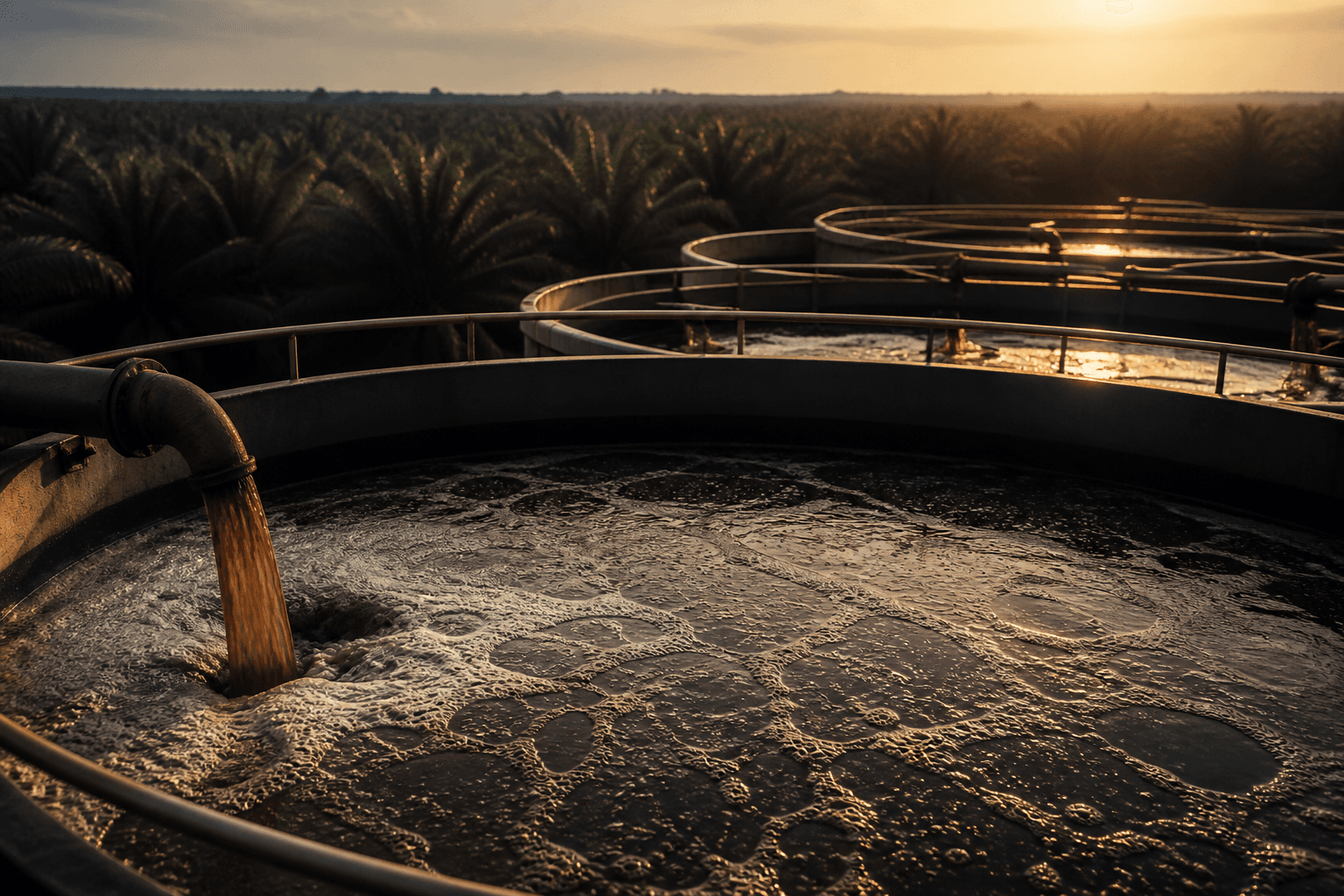
Palm oil mill effluent (POME) and related palm biomass residues — empty fruit bunches (EFB), mesocarp fibre, palm kernel shell — sit at the intersection of plantation economics, biogas and bioenergy policy, and intensifying sustainability scrutiny in Malaysia and Indonesia. For industrial buyers evaluating POME-derived biomass or biogas feedstock, and for suppliers monetising mill waste streams, commercial success depends on moisture and energy content realism, methane capture claims, and documentation that survives buyer ESG review. This overview explains POME as a biomass resource, regional market context, handling constraints, and trading risks.
What POME is and why mills produce it
POME is the liquid waste stream from sterilisation, threshing, and oil clarification in palm oil mills. Raw POME is warm, acidic, high in biochemical oxygen demand (BOD), and rich in organic solids — historically discharged into pond systems where anaerobic digestion occurs naturally, releasing methane. Regulators in Malaysia and Indonesia have pushed mills toward methane capture, biogas power generation, and composting or pelletisation pathways to reduce environmental impact and, in some cases, claim renewable energy credits.
For trading purposes, "POME" on a contract may mean very different things: raw effluent for adjacent biogas plants, digested sludge, dried POME fibre blends, or certificates linked to biogas output. Ambiguous terminology is the first commercial failure mode.
Malaysia and Indonesia: supply context
Malaysia and Indonesia account for the majority of global crude palm oil (CPO) production; each hosts hundreds of mills with associated POME volumes. The Malaysian Palm Oil Board (MPOB) publishes production statistics and technical guidance; Indonesia's policies flow through the Ministry of Agriculture, ISPO certification, and evolving export levy structures on palm products. POME itself is not typically a seaborne bulk export like CPO, but derived biomass products and biogas projects create regional trade in pellets, fibre mixes, and project-level offtake agreements.
Malaysia: biogas and grid connection
Malaysia's Small Renewable Energy Power (SREP) programme and later feed-in tariff mechanisms encouraged mill-attached biogas plants exporting power to the grid. Mills capture methane from digested POME, burn it in gensets, and sell electricity. Surplus digestate may be land-applied as fertiliser or further processed. Buyers of "POME biomass" in Malaysia often contract with mill groups or aggregators for dried fibre or specified waste blends rather than trucking raw effluent cross-border.
Indonesia: scale and compliance pressure
Indonesia's larger mill base faces similar methane mitigation expectations, with ISPO and RSPO audits increasingly reviewing POME management. Cross-border interest in Indonesian palm residues focuses on pellet exports to Japan and Korea (often EFB or PKS rather than POME liquid), and on corporate PPAs for renewable power from biogas. Traceability to mill and estate remains a buyer requirement under deforestation-free sourcing policies.
Source: Malaysian Palm Oil Board (MPOB), annual production and mill statistics; Indonesia Ministry of Agriculture palm estate data; MPOB, Environmental Management Guidelines for the Palm Oil Industry.
POME trading is geographically constrained. Most value is captured within 50–100 km of the mill unless the product is dried, densified, or converted to biomethane for pipeline or compressed use.
POME as biomass: forms and energy content
Raw and digested POME
Raw POME is roughly 95% water; energy value is in dissolved and suspended organics, not suitable for conventional steam boiler firing without substantial treatment. Anaerobic digesters convert organics to biogas (methane-rich); digestate slurry remains high-moisture but reduced BOD. Buyers seeking "biomass" for combustion generally cannot use raw POME — they need solid or semi-solid fractions.
Dried fibre, compost, and blended products
Mills combine mesocarp fibre, EFB, and treated POME solids into compost or dried products for local industrial boilers or export pellet trials. Calorific value depends on moisture and ash; typical green biomass ranges apply once dried to operational storage levels (often target moisture below 15–20% for combustion, product-specific).
Biogas and biomethane
Captured biogas may fuel mill operations, generate electricity, or after upgrading qualify as biomethane for grid injection or transport fuel credits under national renewable schemes. The tradable commodity may be the gas itself, the electricity, or renewable energy certificates — not physical POME liquid.
Moisture: the dominant commercial variable
Moisture drives transport economics, storage stability, and effective energy price. A seller quoting "POME biomass" at 40% moisture versus 15% delivers materially different tonnes of energy per container or truck. Contracts should state:
- As-received vs dry basis for CV and moisture reporting
- Sampling method (ISO standards for solid biofuels where applicable)
- Rejection limits for rain absorption during open storage
- Weight settlement at load vs discharge
Open-yard storage in tropical climates can increase moisture between contract and load; buyers should specify tarping, cover, or indoor storage requirements for export parcels.
Source: ISO 18134 series (moisture determination for solid biofuels); ISO 17225 on solid biofuel specifications (classification principles applicable to biomass pellets and chips).
Related palm residues: EFB, PKS, and mesocarp fibre
Traders often bundle knowledge of POME with other mill outputs because end-use buyers evaluate total biomass portfolio:
- Empty fruit bunches (EFB): High moisture fibrous residue; used in mulching, compost, or pellets after drying/shredding.
- Palm kernel shell (PKS): Lower moisture, higher CV; established export commodity for biomass power in Japan and elsewhere.
- Mesocarp fibre: Burned in mill boilers historically; surplus potentially available for export when mill energy balance allows.
PKS has clearer seaborne trade history than POME-derived solids; buyers comparing options often anchor PKS pricing when evaluating novel POME fibre products.
Source: IEA Bioenergy Task 40, trade flows of biomass pellets and palm kernel shell; Japan Ministry of Economy, Trade and Industry (METI) biomass power plant fuel import statistics.
Sustainability scrutiny and certification
POME and palm residues inherit reputational risk from wider palm oil deforestation and labour debates. Industrial offtakers — power utilities, cement kilns co-firing biomass, and corporate renewable energy buyers — require:
- Traceability to mill and supplying estates
- RSPO, ISPO, or MSPO certification where policy demands
- No deforestation / NDPE compliance under buyer group policies
- GHG accounting for methane capture vs open pond baseline
Biogas projects claiming emissions reductions must document baseline methane release and capture efficiency; greenwashing risk arises when open ponds remain while certificates sell on partial capture.
EU RED and biomass sustainability (indirect relevance)
EU renewable energy rules for solid biomass sustainability criteria apply to imports used for energy — voluntary schemes and national implementations require legality, LULC criteria, and GHG thresholds. POME-derived exports entering European energy supply chains need scheme alignment (e.g. SBP, ISCC) and country-of-origin risk assessment.
Source: Directive (EU) 2018/2001 RED II biomass sustainability criteria; Roundtable on Sustainable Palm Oil (RSPO), Principles and Criteria; Indonesian Sustainable Palm Oil (ISPO) standard.
Sustainability documentation for POME biomass is inseparable from mill and estate provenance. A laboratory CoA without mill GPS coordinates and certification scope fails modern buyer onboarding.
Commercial structures in POME-related trade
Direct mill offtake
Biogas developers or industrial boilers contract directly with mill owners for digestate, fibre, or biogas via long-term agreements indexed to energy prices or fixed gate fees. Volume tied to CPO throughput — seasonal and crop-cycle dependent.
Aggregator and trader role
Traders consolidate PKS or dried fibre from multiple mills for export containers. For POME solids, aggregation requires consistent drying and quality blending. Intermediaries must not overstate volumes beyond mill capacity — a due diligence red flag.
Project finance and RECs
Biogas plants may sell electricity, renewable energy certificates (RECs), or carbon credits. Physical POME movement is internal to the project; external "trade" is in certificates — different legal and documentation regime from bulk biomass.
Handling, storage, and logistics
- Odour and BOD: Raw POME and wet digestate require containment; nuisance and spill liability for road transport.
- Corrosion and contamination: Storage tanks and liners for liquid phases; metal contamination limits for boiler feed.
- Fire and self-heating: Dried fibre stored too wet can self-heat; monitoring per biomass storage guidelines.
- Container export: Only appropriately dried products; inspection for moisture and infestation.
- HS classification: Work with customs broker — palm waste products may fall under fertiliser, biomass, or organic waste headings depending on processing and jurisdiction.
Source: Malaysian Department of Environment (DOE), effluent discharge standards for palm oil mills; World Bank Group, environmental health and safety guidelines for vegetable oil production and processing.
Documentation for buyers and suppliers
Typical supplier documents
- Mill licence and MPOB registration (Malaysia) or equivalent
- Certificate of analysis: moisture, ash, CV, sulphur/chlorine if requested
- RSPO/ISPO/MSPO certificate covering supplying estates
- Commercial invoice and packing list with clear product description (not "POME" alone)
- Phytosanitary or fumigation certificates where importing country requires
- Weight certificate and load photos for containerised shipments
Buyer due diligence questions
- What is annual POME volume and what fraction is captured vs open pond?
- Is the offered product physically exportable or a conceptual "available stream"?
- Does certification cover all contributing estates?
- Are there seasonal shutdowns affecting supply continuity?
Risks and market limitations
Distance and moisture tax: Long-haul export of high-moisture POME-derived material is rarely economic versus local biogas or composting.
Policy change: Export restrictions on palm products or biomass sustainability rules can alter project bankability overnight.
Reputation linkage: Buyer NDPE policies can disqualify mills with unresolved land-use complaints even if POME itself is a waste stream.
Volume exaggeration: Claimed aggregate POME biomass exports exceeding regional drying capacity warrant site audits.
Carbon claim integrity: Certificates from uncaptured ponds undermine GHG marketing claims.
Source: Global Forest Watch and NDPE Implementation Reporting Group publications on palm oil supply chain monitoring; S&P Global Commodity Insights, palm biomass market commentary.
Practical guidance
For suppliers (mills and aggregators)
- Name the product precisely; publish standard moisture and CV ranges from operational data.
- Align certification scope with estates actually feeding the mill.
- Invest in drying/densification before pursuing export rather than quoting raw pond volumes.
- Document methane capture for buyers evaluating GHG attributes.
For industrial buyers
- Benchmark POME solids against PKS and other regional biomass on delivered energy cost.
- Require as-received CV and moisture in payment formulas.
- Verify mill location and capacity before signing volume commitments.
- Separate physical biomass procurement from REC or carbon credit contracts with clear legal structure.
Outlook
Methane mitigation pressure in Malaysia and Indonesia will continue expanding biogas capacity at mills, potentially reducing freely available wet POME while increasing digestate and captured-gas opportunities. Export markets for solid palm residues remain anchored on PKS and pellets with clear moisture specs; POME branding in trade will mature toward specific processed grades rather than generic effluent language. Buyers and suppliers who specify product form, moisture, sustainability scope, and realistic logistics will avoid the failed pilots that litter early "POME export" marketing.
Source: Malaysian Investment Development Authority (MIDA), biogas and biomass energy sector reports; ASEAN Centre for Energy, regional bioenergy deployment summaries.
POME is a mill liability becoming an asset — but only after form, moisture, and provenance are defined with the same rigour as any traded biomass. Treat Malaysia/Indonesia context, sustainability scrutiny, and energy content on an as-received basis as non-negotiable contract terms.